
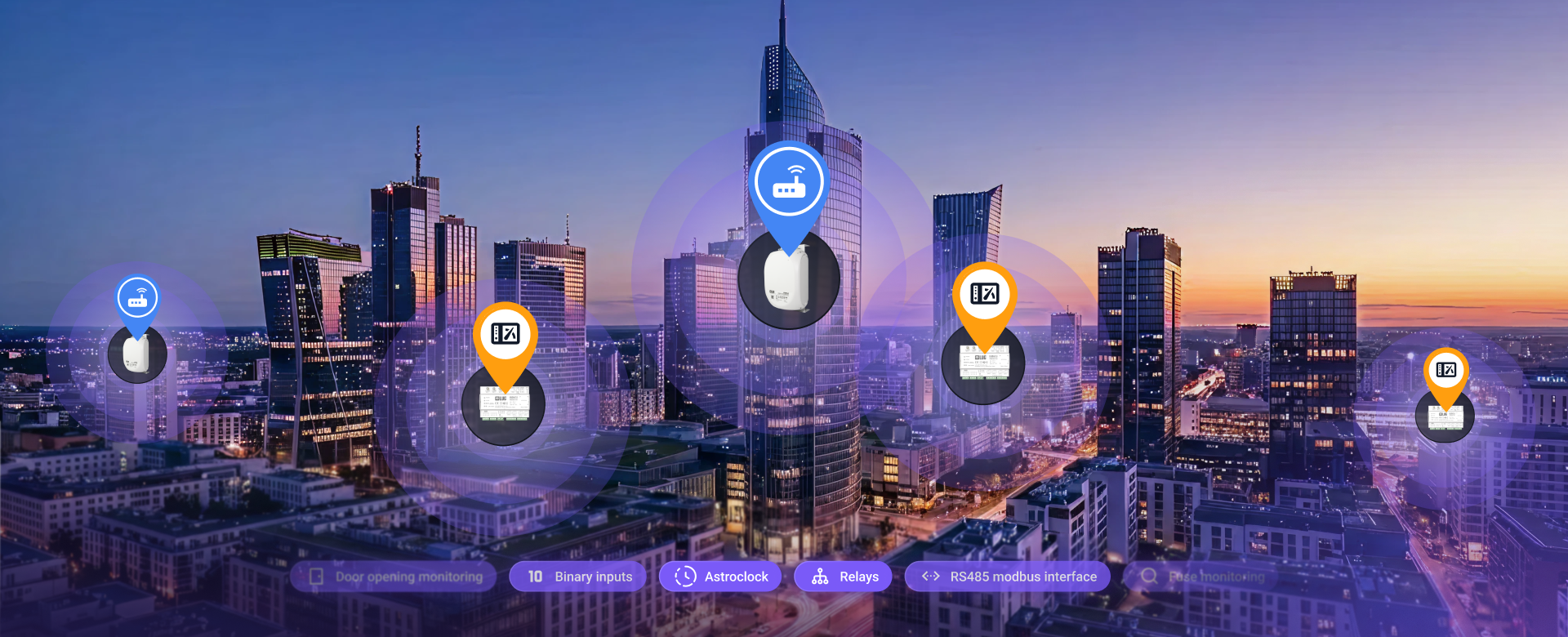
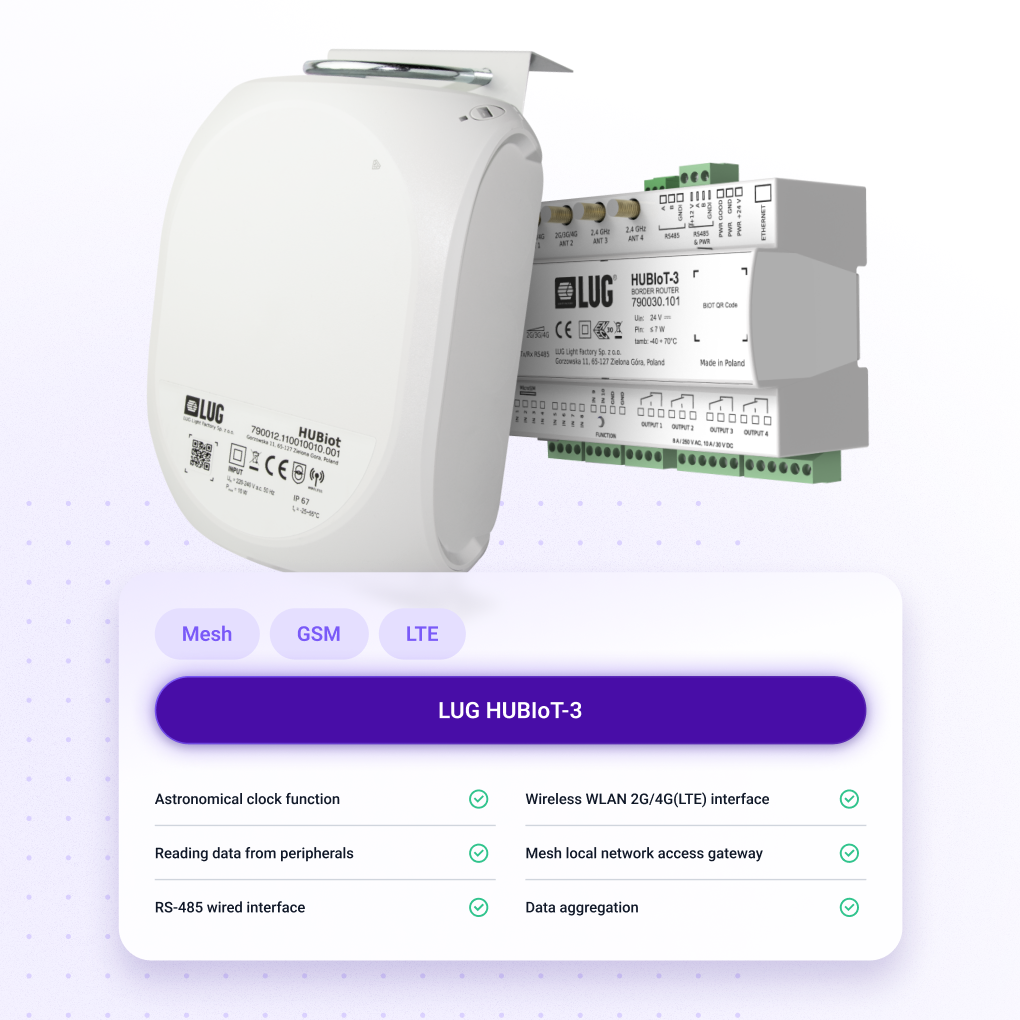
Hubs

Communication hubs
the key to reliable data transmission

Modern streetlight in a city at dusk

Why invest
in communication hubs?

Cost optimization and long-term reliability

This approach extends system autonomy to the local-network level, allowing devices to use locally collected data and improving resilience to temporary central-server unavailability. In such architecture, hubs play a key role in ensuring stable connectivity between IoT devices and central platform servers. This translates into effective monitoring and control, especially when combined with a local mesh network that provides dynamic communication.

Dashboard of a smart lighting system

Technology that ensures reliability

Local network - a second autonomy layer

In a solution supported by a local mesh network, controllers gain a second autonomy layer. A major benefit is high local data availability about the controlled lighting point and its surroundings. For example, on/off control can be supported by current ambient light data from a group of light sensors. This helps eliminate significant measurement errors caused, among others, by birds resting on a sensor.
IoT infrastructure / mainboard

A local network also allows hubs to be installed in locations with the best GSM availability. Some areas have weak GSM coverage. With a mesh-supported architecture, the hub can be moved to a telecom-friendly location while robust mesh mechanisms maintain communication with end devices.

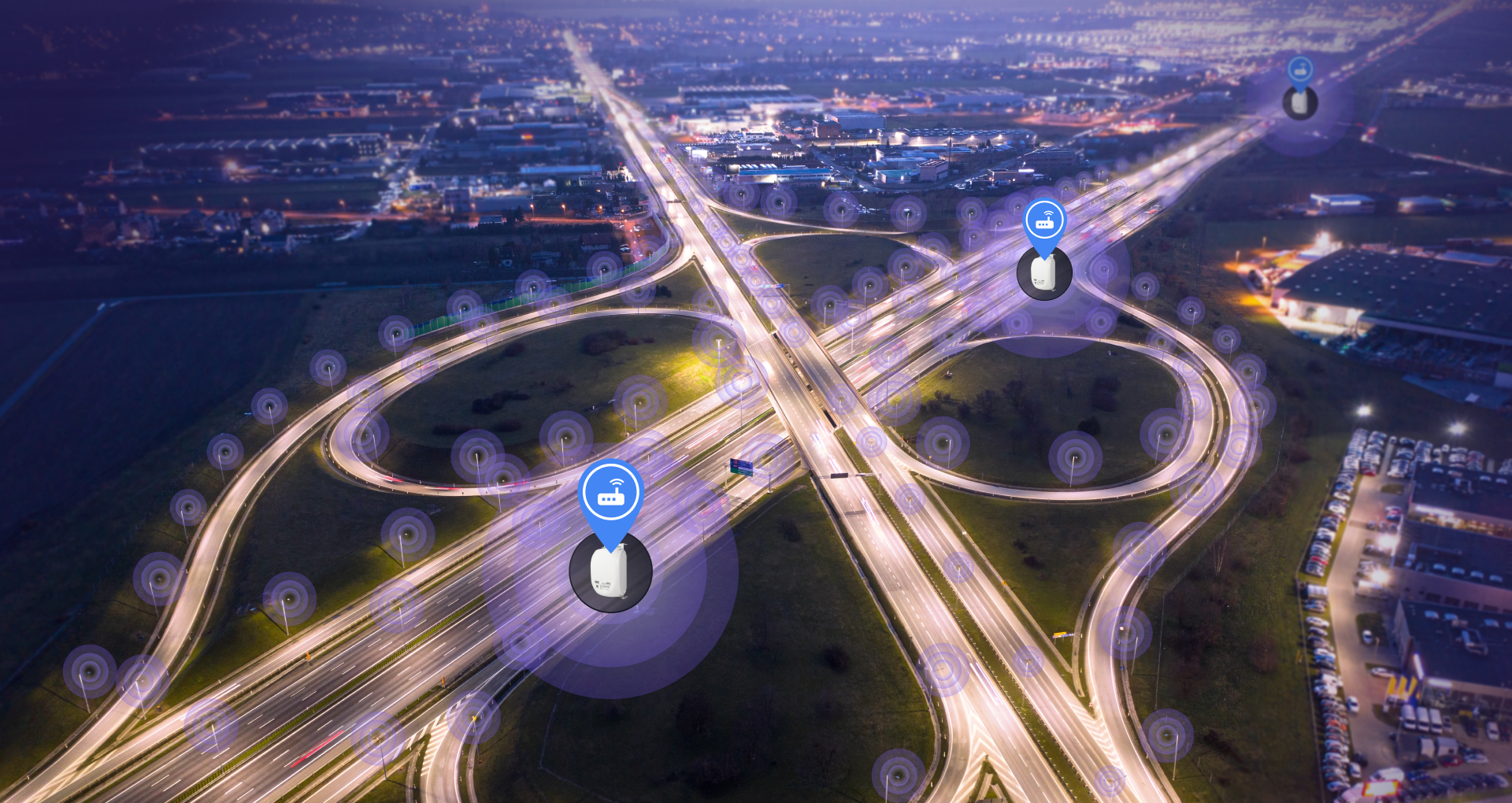
Mesh networking also lowers communication purchase and maintenance costs. One hub can support up to 200 endpoints/controllers, providing continuous connectivity with the central Urban platform.

Integration with BIOT Urban

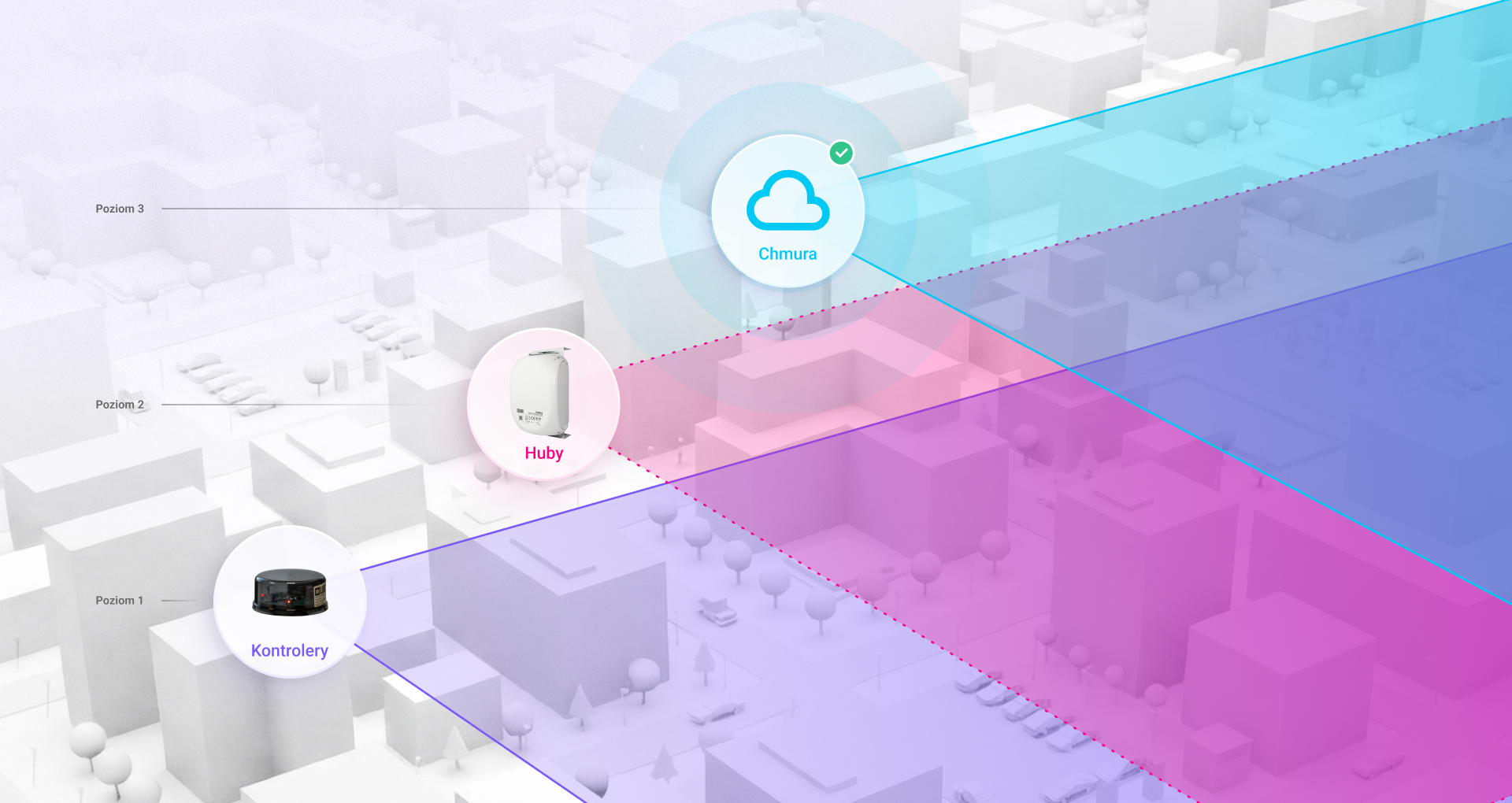
Hubs act as intermediaries between devices operating in the Thread standard and BIOT servers. As a result, users gain access to precise analytics and reports based on real-time data.
Key benefits of our hubs

Reliable connectivity

With modern communication technologies, our IoT hubs provide reliable connectivity even in demanding environmental conditions. The mesh network dynamically reroutes traffic, minimizing packet loss risk.

If central platform servers are temporarily unavailable, the hub archives data from controllers so it can be transmitted when servers are back online.

Installation points

A hub can be installed on a lighting pole or inside a cabinet.

Pole installation makes it easier to choose optimal telecom conditions in locations where GSM signal stability may be insufficient. A good example is short tunnels, where direct communication over several hundred meters is often unavailable. A hub installed before the tunnel entrance can control up to 200 luminaires connected through a high-performance mesh network.

Cabinet installation, in turn, enables additional features such as an astronomical clock built into each device. It also supports wider infrastructure supervision through extra devices, such as an energy meter or a limit switch for monitoring cabinet door opening.

Local communication and automation

Hubs include local communication functions between device clusters, enabling implementation of intelligent control systems, for example:

  • Follow-me lighting

    An autonomous system operating without continuous cloud supervision.

  • Integration with motion and ambient light sensors

    Allows dynamic adjustment of lighting parameters to current conditions.

How to choose the right hub?

Choosing the right HUBIoT gateway variant is a key step in IoT rollout, but you do not have to worry about it.

BIOT will do it for you, taking all critical factors into account, such as:

Transmission range and frequency

Technology selection aligned with the needs of your city or municipality.

Need for lighting-cabinet supervision

Where additional power-grid parameter monitoring is required.

Built-environment specifics

Every area is different, and technology should match local requirements.

Practical applications
of IoT hubs

Sensor integration for full automation

Our hubs can be integrated with a wide range of devices, for example:

Energy meters and power analyzers

Devices that measure energy consumption across the full supply point or selected circuits. With the RS485 interface, all data is sent to the platform.

Expansion devices (input or output ports)

When there is a need to monitor cabinet doors, fuse status, switch positions, and more, the number of digital inputs and relay outputs can be expanded using dedicated modules.

Fuses

Need to know why power is missing? You can identify exactly where a fuse failure occurred, in which cabinet, and on which circuit.

Ambient light sensors

A centrally installed light sensor connected to a given HUBIoT gateway enables lighting intensity control based on weather conditions.

Summary

Communication hubs are an essential element of every modern IoT infrastructure. Thanks to technologies such as mesh, LoRa (LoRaWAN), and LTE, they provide reliable transmission, while integration with BIOT Urban enables efficient data management. Choosing the right hub unlocks full automation potential and operational cost optimization.

Modern BIOT ecosystem with a processor at the center

Questions and answers

A Hub (e.g., HUBIOT-2) is a device that acts as a gateway. It is a central communication point that connects the Urban cloud application with controllers and sensors installed in the field (in Thread mesh technology).
A Hub collects data from controllers (via Thread radio), then forwards it to the Urban cloud. It connects to the internet via a cellular network (GSM 2G/LTE) or wired connection (Ethernet).
In Thread (Mesh) technology, one HUBIoT supports up to a maximum of 200 controllers (depending on individual site conditions). In projects where HUBIoT is responsible for controlling lighting circuits (astroclock), the number will correspond to the number of power cabinets in the field.
No. In the LTE variant (LTE Cat M1), each controller (e.g., eBLOC) has its own built-in GSM modem and communicates directly with the Urban server (cloud). In this scenario, Hubs (gateways) are not used unless the project requires measurements in a power cabinet or control of lighting circuits.
HUBIoT itself is not a meter. In the DIN-rail version, a measurement device (analyzer) can be connected via an interface, and the measurements will be sent to the Urban application.
The device is equipped with binary input interfaces, relay outputs, and an RS485 Modbus communication interface. It allows switching lighting circuits on and off, monitoring fuses and cabinet door status, etc. More information is available in the device datasheet.